
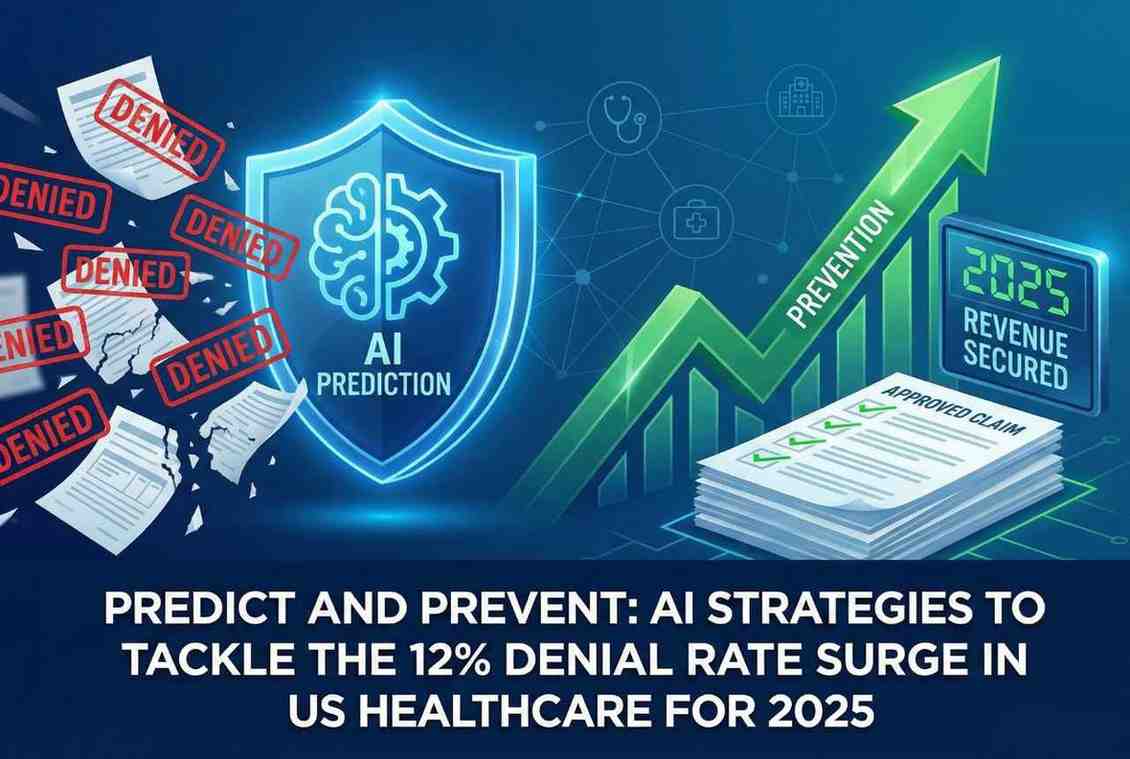
Imagine running a business where every tenth customer walks out without paying—not because they don’t have the money, but because of a paperwork technicality. In 2025, this isn’t a hypothetical nightmare; it is the reality for US healthcare providers facing a 12% surge in claim denial rates.
For years, the industry standard for managing revenue was “chase and appeal.” You submitted a claim, crossed your fingers, and if it bounced, you spent $25 to $118 per claim fighting to get it paid. But in a landscape where payers are now using aggressive AI algorithms to flag claims faster than human teams can review them, the old reactive model is broken.
The future of financial stability in healthcare isn’t about fighting denials—it’s about stopping them before they happen. This is the era of Denial Prediction and Prevention Services, and it is changing the game from “recovery” to “revenue security.”
The “Silent Tax” on Healthcare: Understanding the 2025 Denial Surge
Why are we seeing this sudden spike? The 12% increase isn’t random. It is a perfect storm of three converging factors:
- Weaponized Payer AI: Insurance companies have deployed sophisticated AI models trained to spot even the microscopic coding discrepancies. If your documentation isn’t pixel-perfect, their bots reject it instantly.
- Regulatory Complexity: With constantly shifting policies and new coding requirements for 2025, the margin for human error has vanished.
- Workforce Burnout: Revenue cycle teams are stretched thin. When manual processes meet exhaustion, small mistakes—like a missing modifier or an outdated patient ID—slip through.
This surge creates a “silent tax” on your practice. It’s not just lost revenue; it’s lost time, stalled cash flow, and administrative chaos.
The Shift: From Reactive Recovery to Proactive Prevention
The traditional Revenue Cycle Management (RCM) approach is like driving using only the rearview mirror. You only see the accident after it has happened.
Denial Prediction and Prevention Services flip the script. Instead of asking, “Why was this denied?” after the fact, we now ask, “Will this be denied?” before the submit button is ever pressed.
By leveraging predictive analytics, we can score every single claim against thousands of payer rules, historical data points, and real-time policy updates. If a claim has a 90% probability of denial, it doesn’t go out. It goes to a queue for correction. This simple shift—from post-denial correction to pre-submission optimization—is the single most effective strategy for 2025.
How AI-Driven Prediction Works
It sounds like magic, but it’s math. Here is the mechanics of how Denial Prediction and Prevention Services actually protect your bottom line.
1. Predictive Analytics: The Crystal Ball
Modern algorithms don’t just look for empty fields; they analyze context. They look at historical claims data to recognize patterns. For example, if Payer X has started denying a specific CPT code when paired with a certain diagnosis in the last 30 days, the AI flags your claim immediately—even if the coding is technically “correct” by standard books.
2. Root Cause Forensics
Most denials aren’t one-off errors; they are systemic. Maybe a specific front-desk workflow is consistently missing updated insurance cards, or a particular clinician forgets a specific documentation note. AI dives deep into the data to reveal these root causes, allowing for targeted interventions rather than endless corrections.
3. Automated Workflow Optimization
Imagine having a digital assistant that cleans your claims 24/7. These systems integrate with your existing revenue cycle management (RCM) tools to automate the mundane tasks—like eligibility checks and coding validation—freeing your human experts to focus on complex, high-value issues.
Comparison: Manual vs. AI-Driven Denial Management
To visualize the impact, let’s look at the difference in approach:
| Feature | Traditional Manual Process | AI-Driven Prediction & Prevention |
| Timing | Reactive (After denial) | Proactive (Before submission) |
| Cost | High (Rework costs time & money) | Low (Prevented upfront) |
| Speed | Weeks to months for resolution | Instant correction pre-submission |
| Accuracy | Prone to human error/fatigue | Consistent, data-driven precision |
| Cash Flow | Delayed and unpredictable | Accelerated and consistent |
4 Data Indicators You Must Watch
To truly maximize the benefit of these services, healthcare organizations need to keep their eyes on four specific data indicators. Think of these as the vital signs of your revenue cycle:
- Data Quality & Governance: Garbage in, garbage out. The AI is only as good as the data it is fed. Ensuring your patient records and payer policies are accurate and complete is non-negotiable.
- Integration Health: The best prediction tools need to talk to your Electronic Health Records (EHR) seamlessly. A siloed system is a blind system.
- Payer Collaboration: This is a fresh perspective for 2025. Don’t just fight payers; communicate with them. Understanding their specific tech requirements and feeding that into your prediction model increases accuracy.
- Feedback Loops: When the AI predicts a denial, does your staff understand why? Training your team to interpret these insights is just as important as the technology itself.
The My Billing Provider Difference
While the technology is impressive, technology alone isn’t a silver bullet. We have seen many clinics purchase expensive software that sits unused because it’s too complex or impersonal.
At My Billing Provider, we believe in a hybrid approach. We don’t just hand you a dashboard and wish you luck.
We combine cutting-edge predictive technology with personalized human expertise.
- We Monitor the Trends: Our team stays ahead of the 2025 payer policy shifts so you don’t have to.
- We Customize the Tech: Every practice is unique. We tune our prediction models to your specific specialty, location, and payer mix.
- We proactively Partner: We act as an extension of your office. When our system flags a potential denial, we don’t just auto-correct it; we work with your team to ensure the upstream process is fixed for good.
We are unique because we understand that behind every claim is a patient who needs care and a provider who deserves to be paid.
Conclusion: Secure Your Future Today
The “12% Surge” in denials is a warning shot for the healthcare industry. In 2025, sticking to the old ways of billing isn’t just inefficient—it is a financial risk. By adopting Denial Prediction and Prevention Services, you aren’t just adopting new software; you are adopting a mindset of foresight and stability.
Don’t let algorithms dictate your revenue. Predict the denial, prevent the loss, and protect your practice.
Ready to stop denials before they start?
Contact My Billing Provider today for a free consultation on optimizing your revenue cycle.
