Imagine running a high-volume hospital where every patient discharge is a race against time—not just for bed availability, but for revenue realization. Now, imagine losing 15 cents on every dollar simply because a code was transposed or a comorbidity was missed. This is the reality for many US healthcare providers today.
As we navigate through 2025, the complexity of the Inpatient Prospective Payment System (IPPS) has reached new heights. The sheer volume of data required to accurately assign Inpatient Diagnosis Related Groups (IPDRG) is overwhelming human coders, leading to a spike in preventable denials.
However, a shift is happening. Forward-thinking providers are turning to AI-Powered IPDRG Coding Solutions to stop revenue leakage at the source. This isn’t just about faster typing; it’s about a fundamental restructuring of how we approach clinical data, ensuring that accuracy and efficiency go hand in hand.
The 2025 Landscape: A Report from the Frontlines
Before we discuss the solution, we must understand the scale of the problem. A recent 2025 industry benchmark report from a “Trusted Platform” highlighted startling trends affecting US healthcare providers. While we won’t name specific vendors or clinics, the aggregate data paints a clear picture of the challenges the industry faces.
1. The Denial Epidemic
The report indicates that the average claim denial rate for US providers has hovered around 11.8% in early 2025, with some regions experiencing rates as high as 20%. The primary culprit? Coding errors. Specifically, “soft denials”—those caused by missing documentation or lack of specificity in IPDRG assignments—are on the rise.
2. The Cost of Rework
Financially, the impact is staggering. It is estimated that US providers are losing billions annually not just in denied claims, but in the administrative cost of rework. It costs approximately $25 to $118 per claim just to rework a denial. For a hospital system processing thousands of claims a month, this is a massive drain on resources.
3. The Talent Gap
The report also touched on a critical workforce issue: a projected 12% talent gap in certified medical coders. Burnout is real. Manual coders are being asked to memorize thousands of evolving ICD-10 and CPT codes while navigating complex EMR systems. The result is human error fatigue—where mistakes happen simply because the coder is overworked.
Key Insight: The industry consensus is clear. The traditional, purely manual approach to IPDRG coding is no longer sustainable. Providers need a partner that combines technology with expertise.
How My Billing Provider Fulfills These Needs
This is where My Billing Provider steps in. We analyzed the gaps highlighted in these industry reports—the need for speed, the demand for higher accuracy, and the struggle with compliance—and built our services to address them directly.
We are unique. Unlike generic software vendors that hand you a tool and walk away, we combine cutting-edge AI technology with personalized, human-led service. Our goal is to transform your coding operations from a cost center into a strategic asset.
1. Precision Through Artificial Intelligence
Our powerful algorithms don’t just “read” text; they evaluate complex medical records to understand the clinical context. Whether it’s identifying a hidden Complication or Comorbidity (CC) or capturing a Major Complication or Comorbidity (MCC) that drastically changes the DRG weight, our AI ensures that every code assigned reflects the true acuity of the patient.
2. Streamlining Operations to “Minimize Disturbance”
One of the biggest fears providers have is that new tech will disrupt their workflow. Our solutions fit effortlessly into your existing procedures. We understand that whether you are a tiny clinic or a large hospital network, you cannot afford downtime. Our platform handles your volume and complexity without requiring you to overhaul your current EMR or billing systems.
3. Reducing Errors by 50%
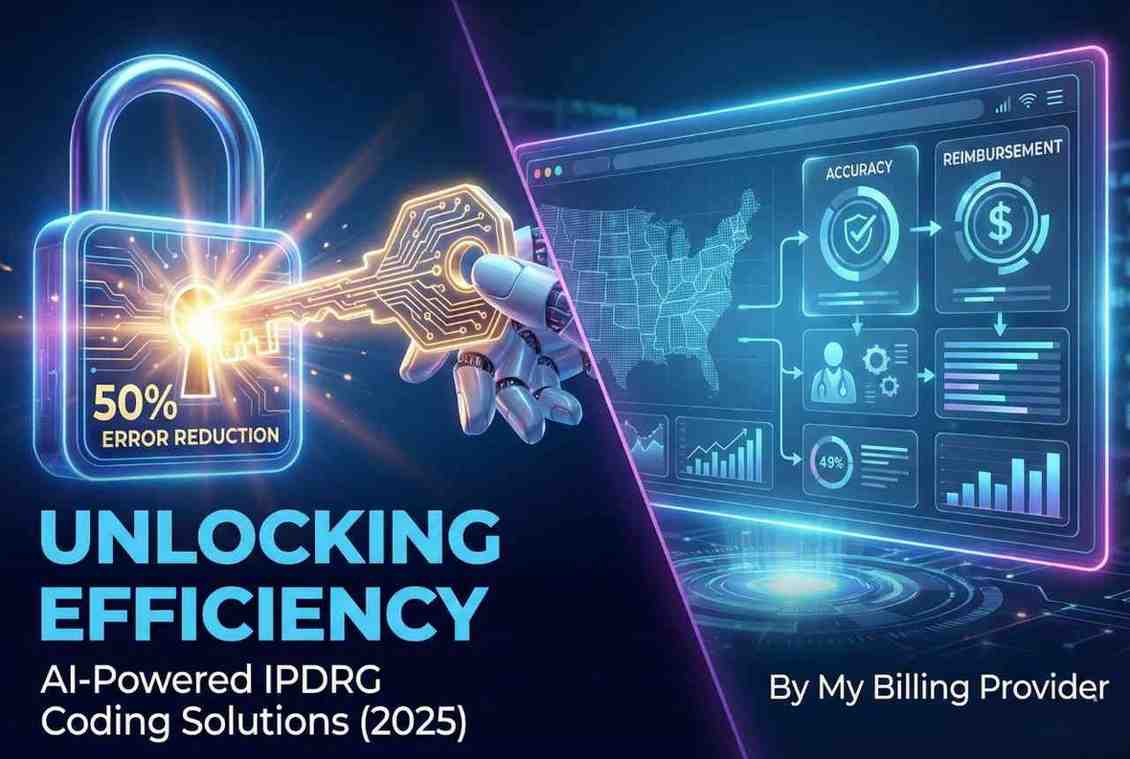
By automating the initial pass of coding and using AI for real-time auditing, we help healthcare firms eliminate common human errors—such as transposition mistakes or missed modifiers. This proactive approach has been shown to reduce coding-related denials by up to 50%, maximizing reimbursement and ensuring you get paid for the care you actually delivered.
The Human-AI Hybrid: A New Standard for Accuracy
There is a misconception that AI replaces human expertise. At My Billing Provider, we believe AI empowers human expertise.
How It Works in Practice
- Data Ingestion: Our AI scans the patient’s electronic health record (EHR), including unstructured data like physician notes and operative reports.
- Code Suggestion: The system suggests the most accurate IPDRG codes based on current 2025 guidelines and clinical indicators.
- Human Validation: Our team of committed professionals reviews the AI’s suggestions. They handle the “grey areas” where clinical judgment is required, ensuring compliance and precision.
- Compliance Check: Before the claim is submitted, the system runs a final check against payer-specific rules to prevent denials before they happen.
This hybrid model allows us to offer the benefits of automated coding—speed and consistency—while retaining the personalized advice and critical thinking of expert coders.
Comparison: Manual vs. AI-Powered Coding
To visualize the impact, let’s look at how a traditional workflow compares to the solution offered by My Billing Provider.
| Feature | Traditional Manual Coding | AI-Powered IPDRG Coding Solutions |
| Speed | Slow; limited by human reading speed. | Instant analysis of massive datasets. |
| Accuracy Rate | Prone to fatigue-based errors (~85-90%). | High precision with continuous learning (~98%+). |
| Compliance | Reactive; relies on coder memory of updates. | Proactive; rules updated in real-time. |
| Scalability | Difficult; requires hiring more staff. | Infinite; scales instantly with patient volume. |
| Cost Efficiency | High operational costs (salaries, training). | Lower cost per claim; reduced denial rework. |
Personal Experience: The “Aha!” Moment
We recently worked with a mid-sized healthcare facility that was struggling with a backlog of unbilled charts. Their coding team was excellent but overwhelmed. They were missing the “15th” of the month reporting deadlines consistently (a pain point many of you might recognize).
When we implemented our AI-Powered IPDRG Coding Solutions, the change wasn’t just in the metrics; it was in the morale. The coding manager told us, “For the first time in two years, my team went home on time during month-end close.”
By automating the routine charts, we freed their experts to focus on the complex cases that truly required their attention. The result? A 40% drop in days in accounts receivable (A/R) within the first quarter.
Why 2025 is the Year to Switch
The healthcare landscape is not getting simpler. Payer audits are becoming more aggressive, using their own AI to find reasons to deny claims. Fighting fire with fire is no longer optional; it is necessary.
At My Billing Provider, we stand out from the competition by focusing on continuous improvement and innovation. We don’t just want to fix your coding for today; we want to future-proof your revenue cycle.
Key Benefits You Can Expect:
- Maximize Reimbursement: Ensure you capture every billable component of care.
- Uncover New Efficiency: Reduce the time from discharge to bill submission.
- Individual Advice: Our team is here to answer your concerns and guide you on your path to better financial performance.
Conclusion
The statistics from 2025 are a wake-up call. With denial rates climbing and the cost of errors rising, sticking to the “old way” of manual IPDRG coding is a risk your practice cannot afford.
AI-Powered IPDRG Coding Solutions are not just a trend; they are the unlock for efficiency that US providers have been waiting for. They offer a way to cut through the noise, reduce errors by half, and secure the revenue your team works so hard to earn.
Are you ready to streamline your IPDRG coding process and improve revenue optimization?
Contact My Billing Provider today to learn more about our AI-powered solutions and how they may help you revolutionize your coding processes. Let’s build a more efficient, profitable future for your healthcare facility together.
