The healthcare administrative landscape in 2026 is at a historic crossroads. For years, we discussed the “impending” shift to ICD-11 and the “potential” of artificial intelligence. Today, those conversations have shifted from theory to urgent operational necessity. With the World Health Organization’s (WHO) 11th Revision now the global benchmark, and payers in the United States increasingly auditing for higher granularity, the margin for error has vanished.
In this new era, AI Medical Coding 2026 is no longer a luxury for large hospital systems; it is a foundational survival tool for every provider. The complexity of ICD-11—with its 55,000+ codes and “cluster” logic—renders manual, chart-by-chart review not only slow but financially risky.
The 2026 Reality: A “Trusted Platform” Perspective
According to the 2026 Healthcare Revenue Cycle Management Trends Report from a leading Trusted Platform, the industry is seeing a decisive move away from legacy Computer-Assisted Coding (CAC) toward fully autonomous workflows. Key highlights from the report include:
- The Complexity Gap: Inpatient coding complexity has risen by 35% since 2024 due to the increased specificity required for social determinants of health (SDOH) and advanced genomic treatments.
- Staffing Crises: 60% of RCM leaders report that finding “ICD-11 ready” certified coders is their primary hurdle, leading to an average 45-day backlog in unbilled charts for those relying solely on manual labor.
- The Adoption Surge: Over 30% of U.S. healthcare organizations have already piloted autonomous coding, reporting a 20% reduction in cycle times.
This data underscores a hard truth: to maintain a healthy revenue cycle in 2026, you must close the gap between clinical documentation and the final claim.
Why ICD-11 Changes the Game for Coding Efficiency
Transitioning to ICD-11 isn’t just an “update”; it’s a complete architectural reimagining. Unlike the linear structure of ICD-10, ICD-11 is a digital-first system that uses Post-Coordination (code clustering).
From Linear Codes to “Clustered” Logic
In the old system, you searched for a single pre-coordinated code. In ICD-11, you use a “stem code” and attach “extension codes” to describe severity, laterality, and etiology.
- Manual Difficulty: For a human coder, “building” these clusters manually for every patient encounter is time-intensive and prone to “under-coding” to save time.
- AI’s Advantage: An Automated ICD Tool thrives on this logic. It can instantly cross-reference a physician’s note about a “Stage 3 pressure injury on the right heel” and generate the correct multi-code cluster in milliseconds.
4 Pillars of AI-Driven Coding Success in 2026
To achieve peak performance, organizations are focusing on four critical areas where AI transforms the administrative burden into a strategic asset.
1. Enhancing AI Coding Accuracy
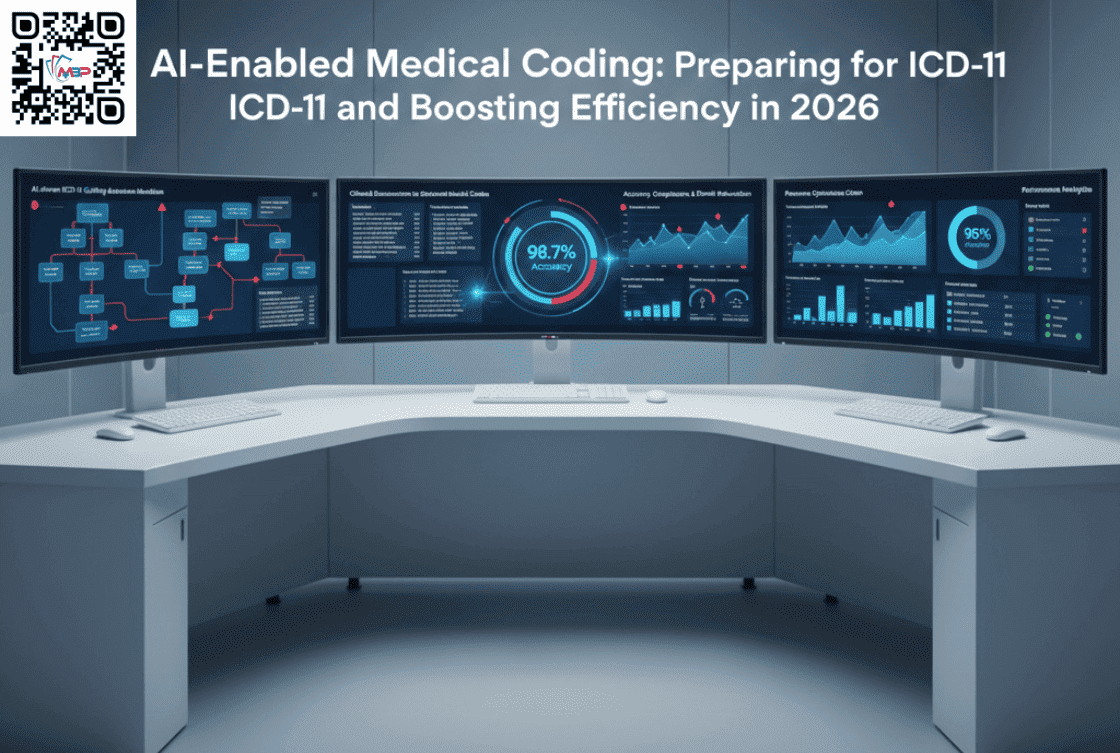
In 2026, “close enough” is a recipe for a denial. AI Coding Accuracy has reached a point where systems can achieve 96% first-pass accuracy. These systems use Deep Learning to understand medical nuances—distinguishing between a patient “screened for” a condition versus “diagnosed with” one—reducing the “unspecified” codes that trigger payer audits.
2. Streamlining ICD-11 Coding Automation
The sheer volume of new entities in ICD-11 (over 55,000) makes traditional search tools obsolete. ICD-11 Coding Automation utilizes Natural Language Processing (NLP) to read unstructured physician notes, operative reports, and discharge summaries, mapping them directly to the new global standards without requiring the coder to memorize new hierarchies.
3. Bridging the Gap with Clinical Documentation AI
The root of most billing denials isn’t the coder; it’s the documentation. Clinical Documentation AI acts as a real-time bridge. While the physician is still in the chart, the AI can “nudge” them for missing details required for an ICD-11 cluster, such as the specific anatomical site or the underlying cause of a symptom.
4. Continuous Payer Rule Adaptation
In 2026, insurance rules change weekly, not annually. AI systems now automatically ingest these changes, ensuring that the “Automated ICD Tool” is always billing according to the latest specific payer contracts, preventing “technical denials” before they happen.
Comparison: Manual Coding vs. AI-Enabled Coding (2026 Metrics)
| Feature | Manual Coding (2026) | AI-Enabled Coding (2026) |
| Chart Review Speed | 15–20 mins / complex chart | < 2 seconds / chart |
| Accuracy Rate | 82% – 88% (Avg) | 95% – 98% |
| ICD-11 Readiness | Requires 60+ hrs of training | Native / “Off-the-shelf” |
| Denial Rate | 10% – 15% | < 3% |
| Cost Per Chart | $5.00 – $7.50 | $1.50 – $2.50 |
How “My Billing Provider” Solves the 2026 Coding Crisis
While the industry landscape is shifting, My Billing Provider has built the definitive ecosystem to manage this transition. We provide cutting-edge AI-powered IPDRG coding solutions that transform how you manage your revenue.
The Power of Precision IPDRG Coding
At My Billing Provider, our technology doesn’t just “suggest” codes; it interprets the clinical intent.
- Accuracy & Efficiency: Our algorithms evaluate complex medical records and assign IPDRG codes with surgical precision, ensuring industry compliance and maximizing reimbursement.
- Customizable for Any Scale: Whether you’re a specialized clinic or a massive hospital network, our platform handles your volume while integrating seamlessly into your existing EHR (Epic, Cerner, NextGen, etc.).
- Minimized Disturbance: We focus on “plug-and-play” efficiency, meaning your team can start reaping the benefits of automated coding without weeks of downtime or massive retraining.
Our mission at My Billing Provider is to move your coding from a back-office bottleneck to a strategic lever that accelerates cash flow and reduces staff burnout.
Conclusion: Leading the ICD-11 Transition
The 2026 coding environment is undeniably more complex, but it also offers an unprecedented opportunity for data-driven growth. By moving to AI Medical Coding 2026, you aren’t just automating a task; you are future-proofing your entire organization against the volatility of global health updates.
Don’t let the weight of 55,000 new codes and rising denial rates hold your practice back. Embrace the tools that allow your team to work at the top of their license, focusing on complex audits and patient care while the AI handles the documentation drudgery.
Are you ready to revolutionize your IPDRG coding and secure your 2026 revenue?Contact My Billing Provider today to explore our AI-powered solutions. Our team of experts is ready to provide a personalized demo and help you chart a course toward better coding accuracy and long-term financial performance.
