The healthcare financial ecosystem of 2026 is unrecognizable compared to just a few years ago. We have entered an era where “administrative precision” is no longer a goal—it is a requirement for survival. As payers deploy high-velocity AI to scrutinize claims in milliseconds, healthcare providers are finding that the biggest threat to their bottom line isn’t the cost of care, but the “Verification Gap.”
Recent data from leading industry intelligence platforms indicates that nearly 1 in 5 in-network claims are now denied initially, with a staggering 25% of those rejections stemming directly from eligibility and registration errors. In an environment where Medicaid redeterminations and ACA subsidy shifts create constant coverage volatility, the old “bill now, verify later” approach is a primary driver of revenue leakage.
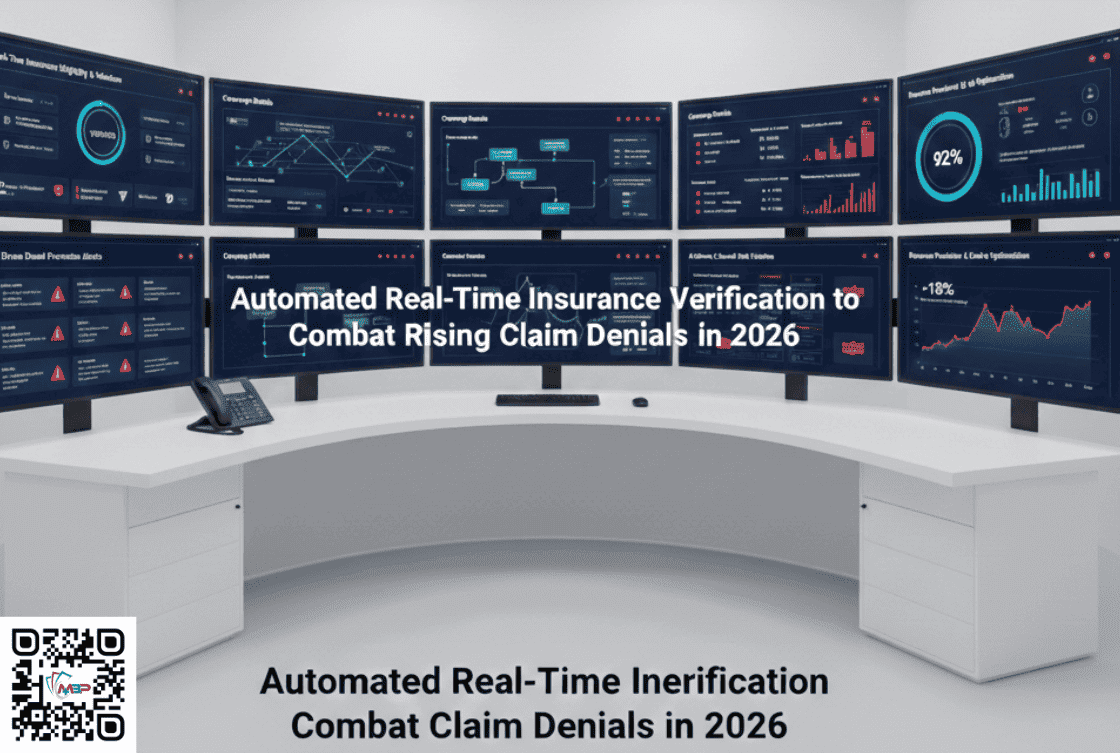
The solution defining 2026 is Automated Insurance Verification 2026. By shifting from manual, portal-hopping lookups to autonomous, instant validation, providers are finally plugging the holes in their revenue cycles before the patient even walks through the door.
The 2026 Denial Crisis: Why the Old Way is Breaking
In 2026, the sheer volume of clinical and insurance data has surpassed human capacity for manual tracking. Patients are switching plans more frequently, and high-deductible health plans (HDHPs) have made the “remaining deductible” a moving target that changes daily.
The Cost of Manual Friction
When a front-desk staff member relies on outdated portals or—worse—manual phone calls to verify coverage, the margin for error is massive. A single typo in a subscriber ID or a failure to notice a recently met deductible leads to a denial that costs an average of $43.84 per claim to appeal. For a mid-sized facility, this “administrative friction” can erode net margins by 3-5% annually.
4 Strategic Pillars of Real-Time Eligibility in 2026
To combat these losses, high-performing RCM teams are adopting Real-Time Eligibility Checks that go beyond a simple “active/inactive” status.
1. Instant API-Driven Adjudication
Modern systems no longer wait for a human to log into a payer portal. Instead, they use direct API connectivity to perform checks in under five seconds. These systems pull granular data including:
- Specific co-insurance percentages for the scheduled procedure.
- Telehealth vs. in-person coverage variations.
- Coordination of Benefits (COB) to identify primary and secondary payers accurately.
2. Zero-Day “Self-Healing” Registration
In 2026, Insurance Verification Software is moving toward “self-healing” workflows. If the AI detects an eligibility mismatch during pre-registration, it can autonomously trigger a notification to the patient, asking them to upload a photo of their new card. The system parses the image, updates the EHR, and re-verifies the claim—all without a staff member lifting a finger.
3. Predictive Denial Prevention
Verification is no longer just about checking “is the insurance good?” It’s about Denial Prevention Verification. Advanced AI models now analyze a payer’s current “denial behavior” in real-time. If a specific payer is suddenly denying a certain CPT code due to new prior authorization rules, the verification tool flags the visit before care is rendered.
4. Automated Healthcare Payment Posting
When insurance is verified correctly upfront, the downstream benefits are immense. Clean data leads to accurate Healthcare Payment Posting. In 2026, integrated systems ensure that when a payment is received, it matches the verified benefit perfectly, allowing for auto-reconciliation and reducing the need for manual audit cycles.
The ROI of Automation: A 2026 Metric Comparison
| Performance Metric | Manual Verification (Legacy) | Automated Real-Time (2026) |
| Verification Speed | 10–15 minutes per patient | < 5 seconds |
| First-Pass Acceptance Rate | 70% – 78% | 94% – 96% |
| Average Days in A/R | 45+ Days | < 25 Days |
| Staff Efficiency | High Burnout / Repetitive Tasks | Strategic / Patient-Facing Focus |
How “My Billing Provider” Seals the Leaks in Your Revenue Cycle
At My Billing Provider, we recognize that insurance verification is the “first domino” in the revenue cycle. If it falls correctly, the rest of the process—coding, billing, and payment posting—follows seamlessly. If it fails, the entire system collapses into a cycle of denials and rework.
Our AI-Powered Ecosystem
While many vendors offer standalone tools, My Billing Provider provides a unified, cutting-edge solution designed for the 2026 regulatory environment.
- Precision IPDRG Coding: Our platform doesn’t just verify coverage; it uses powerful algorithms to evaluate complex medical records and assign IPDRG codes with surgical precision, ensuring that the billed services match the patient’s specific plan benefits.
- Customizable & Scalable: Whether you are a small clinic or a large hospital network, our flexible platform handles your volume and complexity without disturbing existing workflows.
- Maximized Reimbursement: We use artificial intelligence to help healthcare firms eliminate errors and capture every dollar they are owed.
By utilizing My Billing Provider, you aren’t just buying software; you are acquiring a strategic partner in revenue integrity.
Conclusion: Turning Verification into a Strategic Advantage
In 2026, the most successful healthcare organizations are those that treat eligibility verification not as a “check-in” task, but as a strategic revenue control point. By adopting Automated Insurance Verification 2026, you eliminate the guesswork, reduce administrative burnout, and—most importantly—ensure you are paid fairly and promptly for the care you provide.
The technology is no longer a luxury; it is the foundation of a healthy medical practice.
Is your front-end process leaking revenue through outdated manual checks?Contact My Billing Provider today to learn more about our AI-powered solutions. Our committed team of professionals is here to answer your concerns, provide individual advice, and help you on your path to better financial performance.
