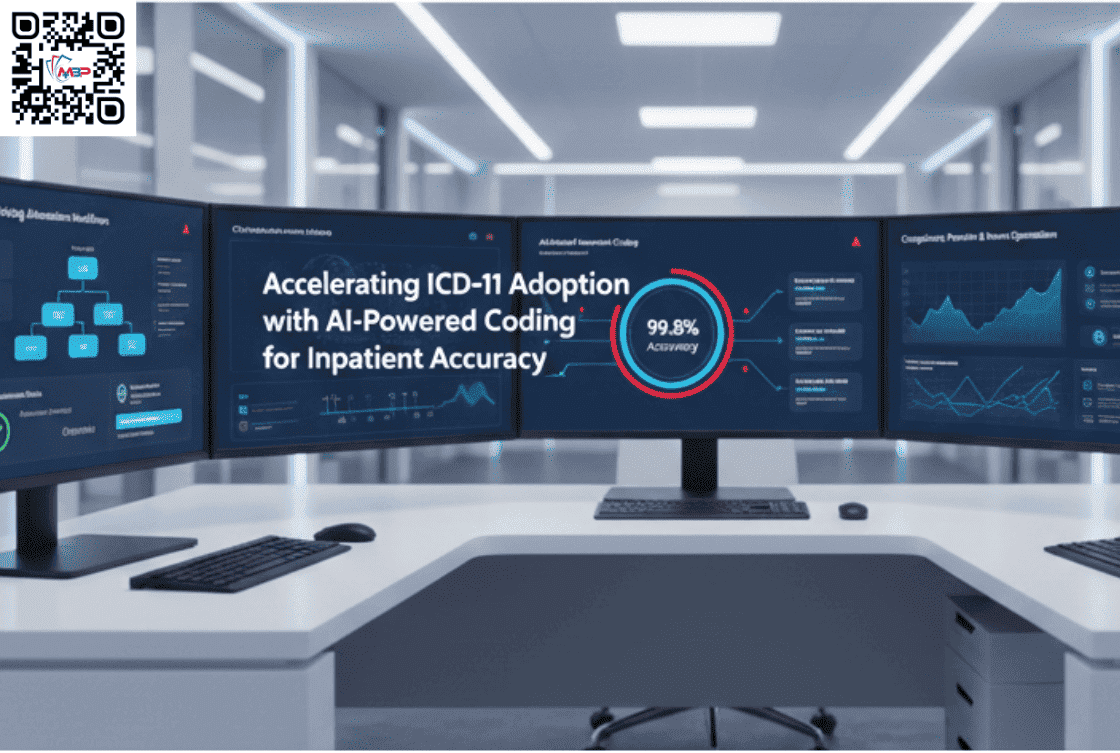
The healthcare industry is currently navigating its most significant data transformation in three decades. As of 2026, the global shift toward the 11th Revision of the International Classification of Diseases (ICD-11) has moved from a theoretical milestone to an operational mandate. For inpatient facilities, where complexity is the norm, the stakes of this transition are measured in both clinical precision and financial viability.
Traditional manual coding, which already struggles under the weight of ICD-10’s 14,000 codes, is ill-equipped for ICD-11’s staggering 55,000+ code entities. The solution emerging as the industry standard is ICD-11 Adoption AI. By leveraging artificial intelligence, hospitals are not just “surviving” the switch; they are using it as a catalyst to redefine inpatient accuracy and revenue integrity.
The 2026 Landscape: Why ICD-11 is a Different Kind of Challenge
Unlike the move from ICD-9 to ICD-10, which was largely a linear expansion of codes, ICD-11 is a fundamental architectural shift. It is a “digital-first” system built on a framework of post-coordination—a method where multiple codes (stem codes and extension codes) are clustered together to describe a single clinical concept.
Highlights from the 2026 Trusted Platform Report
A recent report by a leading healthcare intelligence platform highlights critical trends that are shaping the current Inpatient Coding Transition:
- Complexity Gap: Human coders take approximately 40% longer to code complex inpatient cases in ICD-11 due to the new clustered structure.
- Accuracy Paradox: While ICD-11 allows for greater detail, early manual adoption has actually seen a temporary 15% increase in “unspecified” codes as staff struggle with the new hierarchy.
- Denial Sensitivity: Payers have updated their “denial engines” with AI that specifically flags improper post-coordination, making precision more critical than ever.
3 Strategic Pillars of AI-Driven ICD-11 Adoption
To master the transition, healthcare leaders are focusing on three core strategies where AI acts as the primary engine for success.
1. Mastering Post-Coordination with NLU
In ICD-11, you don’t just “find” a code; you “build” one. For example, a “fracture of the femur” must now be clustered with codes for the specific site, the type of fracture, and the cause of injury. IPDRG AI Coding utilizes Natural Language Understanding (NLU) to scan physician notes and automatically suggest these clusters. This removes the cognitive load from the coder, ensuring that every detail documented is reflected in the final claim.
2. Safeguarding the ICD-11 Revenue Impact
One of the biggest fears for CFOs is the ICD-11 Revenue Impact. Because payment models like DRGs are based on these codes, a slight shift in logic can lead to significant revenue leakage. AI tools allow for “shadow coding,” where the system calculates reimbursement under both the old and new standards. This enables facilities to identify potential fiscal gaps and adjust their Clinical Documentation Improvement (CDI) programs months before full implementation.
3. Real-Time AI IPDRG Compliance
In 2026, compliance isn’t a retrospective audit—it’s a real-time requirement. AI IPDRG Compliance tools act as a final “sanity check.” They ensure that the assigned ICD-11 clusters logically align with the DRG assignment and the patient’s clinical pathway, flagging discrepancies before the claim is submitted to the payer.
Comparison: Manual vs. AI-Augmented Adoption
| Feature | Manual ICD-11 Transition | AI-Augmented Transition |
| Search Method | Index-based (Slow) | Context-aware NLU (Instant) |
| Code Structure | Struggle with clustering | Native support for post-coordination |
| Staff Training | 60+ hours per coder | Automated “on-the-job” assistance |
| Accuracy Rate | 70% – 80% (initial) | 95% – 98% |
| Revenue Stability | High volatility risk | Predictive and protected |
How “My Billing Provider” Fulfills Your Coding Needs
At My Billing Provider, we recognize that the transition to ICD-11 is not just an administrative task—it is a transformation of your entire data ecosystem. Our platform is designed to meet the rigorous demands of 2026 with cutting-edge IPDRG AI Coding solutions.
Transforming Inpatient Operations
We provide the technology and expertise needed to streamline your most complex coding procedures.
- Advanced Algorithms: Our system evaluates medical records with a depth that matches human clinical reasoning, assigning precise IPDRG codes while minimizing errors.
- Customizable Scalability: Whether you manage a rural hospital or a multi-state network, our flexible platform adapts to your volume and specific clinical nuances.
- Revenue Optimization: We don’t just assign codes; we help you uncover new efficiencies in your revenue cycle management, ensuring you are reimbursed fairly for the level of care provided.
By choosing My Billing Provider, you are empowering your staff to focus on high-value clinical analysis while the AI handles the heavy lifting of modern classification logic.
Conclusion: Turning Complexity into a Competitive Edge
The transition to ICD-11 is inevitable, but the stress associated with it doesn’t have to be. For organizations that embrace ICD-11 Adoption AI, 2026 represents an opportunity to build a more accurate, data-rich, and financially resilient health system. By automating the routine and providing real-time intelligence for the complex, you can ensure that your facility remains at the forefront of modern medicine.
Are you ready to future-proof your inpatient coding and protect your revenue?
Contact My Billing Provider today to learn more about our AI-powered solutions. Our dedicated team of professionals is ready to provide individual advice and help you navigate your journey to better coding accuracy and financial performance.
