
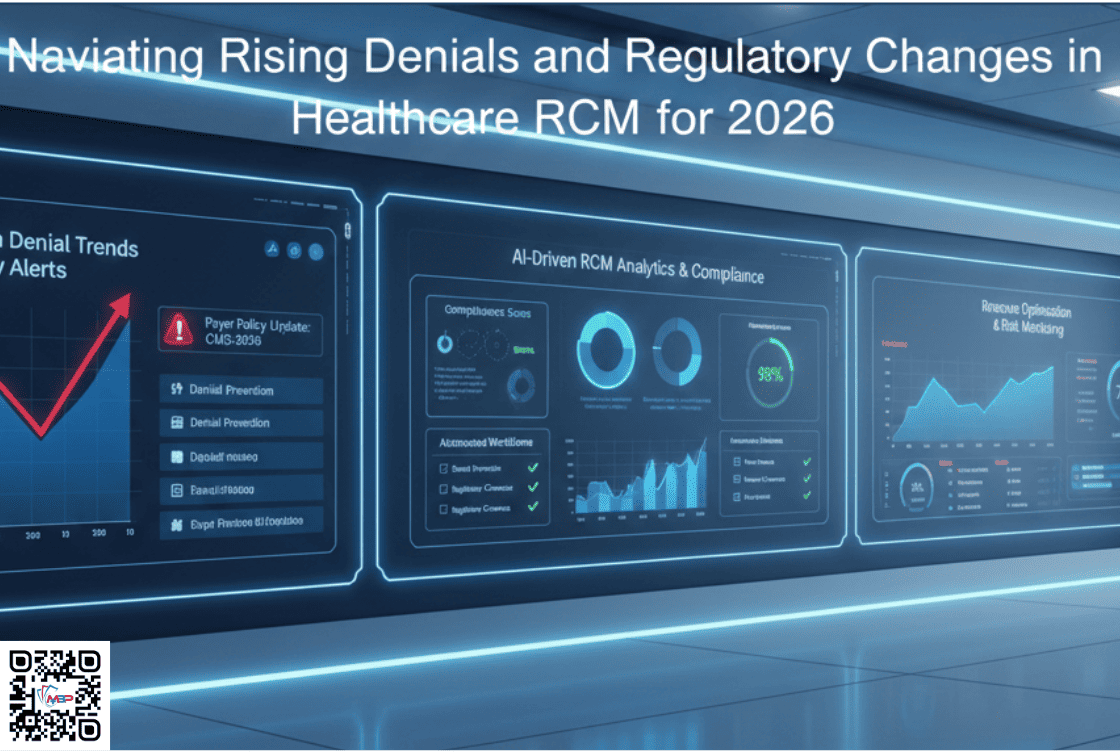
The healthcare financial ecosystem has reached a breaking point. In 2026, the traditional “bill and wait” model has been replaced by a high-stakes chess match between providers and payers. With denial rates hovering near 10%—and spiking as high as 20% for high-cost procedures—healthcare leaders are no longer just fighting for revenue; they are fighting for the operational viability of their institutions.
The primary driver of this shift? Healthcare RCM Trends 2026 are now dominated by a “technological arms race.” Payers are increasingly using advanced AI to scrutinize claims with surgical precision, while providers are scrambling to modernize their defenses. Navigating this landscape requires more than just better software—it requires a fundamental reimagining of the revenue cycle from the front desk to the back office.
The Perfect Storm: Why Denials are Skyrocketing in 2026
If 2024 was the year of AI experimentation, 2026 is the year of AI enforcement. According to a recent industry report by a Trusted Platform, several factors have converged to create a challenging reimbursement environment:
- Payer-Side AI Audits: Payers now use Natural Language Processing (NLP) to scan physician notes in milliseconds, automatically triggering revenue cycle denials 2026 if the clinical documentation doesn’t perfectly mirror the billed code.
- The “Eligibility Cliff”: Ongoing shifts in Medicaid redeterminations and the expiration of various federal subsidies have led to “eligibility volatility.” Patients often present with insurance that was active 30 days ago but has since lapsed or shifted to a different tier.
- The One Big Beautiful Bill Act (OBBBA): This major 2026 reform has introduced stricter transparency requirements, forcing providers to deliver precise “Good Faith Estimates” for nearly all services, or face immediate claim rejection.
2026 Regulatory Landscape: Beyond Just HIPAA
Compliance is no longer a “check-the-box” annual activity. In 2026, regulatory compliance RCM is a real-time operational requirement.
1. CMS Interoperability & Prior Authorization Rule
The most significant change this year is the full implementation of the CMS Interoperability Rule. Payers are now required to provide “near-instant” responses to prior authorization requests—but only if the provider submits them through a specific, standardized API.
2. Tightened Documentation Standards (E/M 2026)
CMS has further refined Evaluation and Management (E/M) guidelines, shifting the focus almost entirely to “Medical Decision Making” (MDM). Vague documentation that doesn’t explicitly state the complexity of the patient’s condition is now the #1 cause of downcoding.
| Regulatory Focus | 2024 Requirement | 2026 Reality |
| Prior Authorization | Manual/Portal-based | Mandatory API-driven Electronic PA |
| Patient Estimates | High-level estimates | Binding “Good Faith Estimates” (NSA/OBBBA) |
| Audit Frequency | Periodic/Targeted | Continuous AI-driven “Rolling” Audits |
| Telehealth | Flexible Coding | Rigid, Permanent Modifiers and Site Requirements |
Shifting from Defense to Offense: RCM Strategies for 2026
To stay ahead, healthcare organizations are moving away from reactive “denial management” and toward proactive “denial prevention.” This involves three core pillars of RCM automation strategies:
Pillar 1: Predictive Denial Scoring
In 2026, successful billing teams don’t wait for a rejection letter. They use AI revenue optimization tools to “score” every claim before it leaves the clearinghouse. If a claim has a >70% probability of being denied based on historical payer patterns, the system automatically routes it back to a coder for correction.
Pillar 2: Clinical Documentation Integrity (CDI) at the Point of Care
The gap between clinical care and financial reimbursement is closing. AI “Scribes” and documentation assistants now alert physicians in real-time if a diagnosis requires a specific secondary code to support the billed level of service. This eliminates the “swivel-chair” work where coders have to chase doctors weeks after the patient has been discharged.
Pillar 3: Agentic AI for Appeals
When a denial does slip through, manual appeals are too slow to be profitable. Agentic AI—autonomous systems that can “reason” through a payer’s denial reason—can now draft, cite medical literature, and submit appeals without human intervention, reducing the cost-to-collect by over 40%.
How “My Billing Provider” Solves the 2026 RCM Crisis
While the industry faces unprecedented hurdles, My Billing Provider was built for this exact moment. We don’t just provide software; we provide an autonomous ecosystem that bridges the gap between clinical complexity and financial accuracy.
Revolutionary AI-Powered IPDRG Coding
At My Billing Provider, we specialize in cutting-edge IPDRG coding solutions that transform how hospitals and large clinics manage their mid-cycle.
- Precision Algorithms: Our powerful algorithms evaluate complex medical records, ensuring that every comorbid condition is captured and every IPDRG code is assigned with surgical precision.
- Industry Compliance: Our platform is updated in real-time to reflect the latest 2026 CMS and payer-specific rule changes. You never have to worry about “outdated logic” leading to an audit.
- Efficiency at Scale: Whether you handle 1,000 or 100,000 encounters, our flexible platform scales with you, minimizing disruptions and maximizing your clean-claim rate.
[Image showing the comparison between manual coding speed/accuracy and AI-powered autonomous coding]
The “My Billing Provider” Advantage
We believe that AI should help healthcare firms streamline their operations, not complicate them. By leveraging our AI revenue optimization tools, your team can move from “fighting fires” to “strategic growth.” We help you uncover hidden efficiencies in your revenue cycle, ensuring you are reimbursed fairly for the high-quality care you provide.
Conclusion: The Future belongs to the Prepared
The “Denial Crisis” of 2026 is not going away. Payers will continue to tighten their rules, and regulations will continue to evolve. The question is: Will your revenue cycle remain a manual, reactive bottleneck, or will it become a streamlined, AI-driven engine for growth?
By adopting modern healthcare RCM trends 2026 and partnering with a technology leader like My Billing Provider, you can safeguard your financial performance and return your focus to what matters most—the patient.
Are you ready to eliminate the guesswork from your billing process?
Contact My Billing Provider today for a personalized audit of your current coding accuracy. Our team of experts is ready to help you navigate the complexities of 2026 and beyond
