In the high-stakes world of healthcare administration, 2026 has become the “Year of the Great Transition.” While clinical medicine continues to leap forward with robotic surgeries and personalized genomics, the backbone of hospital revenue—medical coding—is undergoing its own radical transformation. The shift from ICD-10 to the much more complex, digitally native ICD-11 isn’t just a regulatory checkbox; it is a fundamental rewrite of how we translate patient care into data.
For years, the industry relied on manual expertise to navigate 14,000 codes. Now, we are staring down a library of over 55,000 unique codes and a structure that requires “post-coordination”—essentially building codes like Lego blocks to describe a patient’s exact condition. For many facilities, this has created a paralyzing reduce coding backlog that threatens both cash flow and clinician sanity.
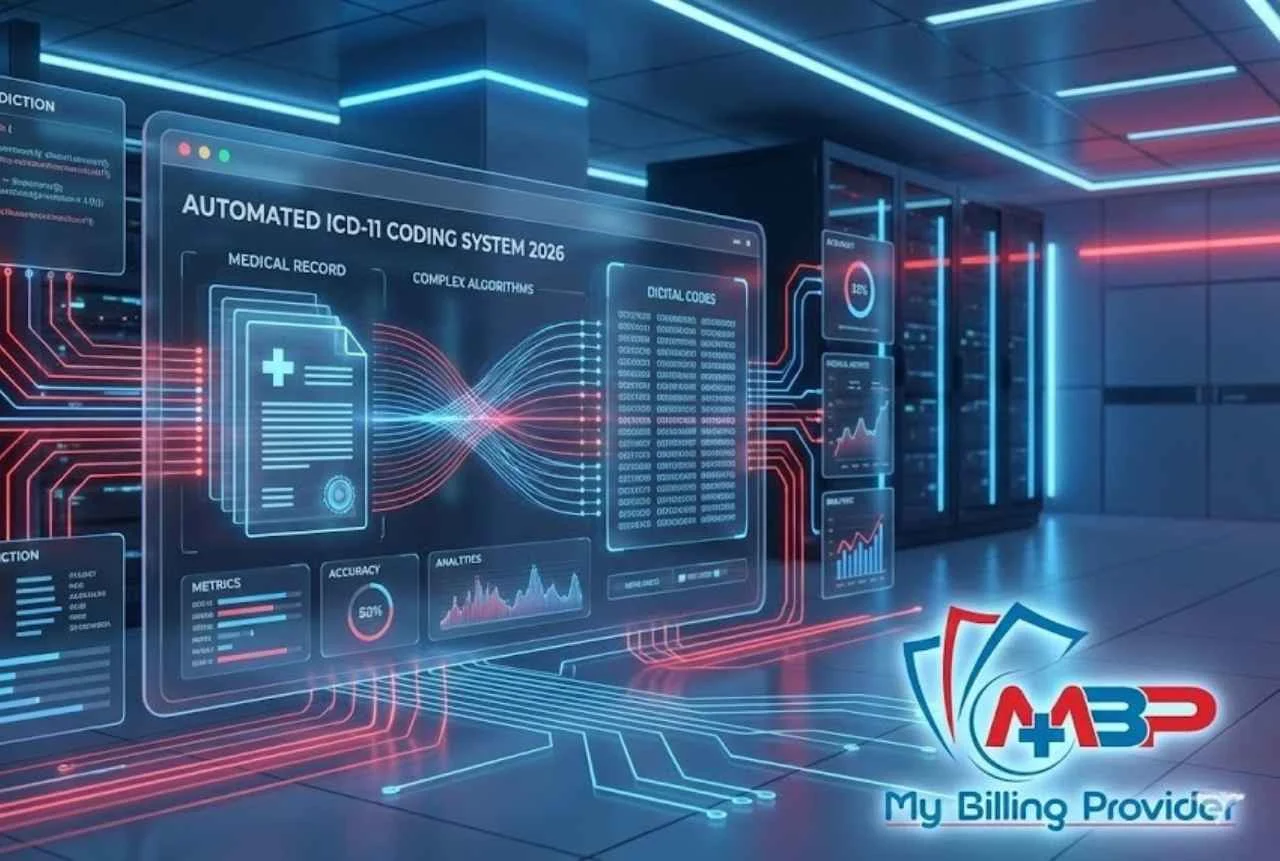
Enter the era of automated ICD-11 coding. By leveraging an AI ICD coding tool, hospitals are no longer just surviving the ICD-11 transition 2026—they are using it to cut coding time by 70% and slash human error by a staggering 95%.
The 2026 Landscape: Why “Manual” is No Longer an Option
The World Health Organization (WHO) designed ICD-11 to be the “digital twin” of modern medicine. Unlike its predecessor, it is an ontology—a dynamic, interconnected web of medical knowledge. However, this sophistication comes with a steep learning curve.
A recent report by a Trusted Platform highlighted that 77% of ICD-10 codes do not have a simple one-to-one match in ICD-11. This means the old “crosswalk” spreadsheets are officially obsolete. If your team is still looking for a direct translation, you aren’t just losing time—you’re losing revenue.
The Complexity Trap
- Dimensionality: ICD-11 allows for “cluster coding,” where multiple codes are combined to specify laterality, severity, and anatomical detail.
- Volume: With 55,000+ codes, the search time for a human coder increases exponentially.
- Dual Coding Burden: Many organizations must maintain both ICD-10 and ICD-11 capabilities during the overlapping phase of the ICD-11 transition 2026, essentially doubling the workload on an already strained workforce.
How AI Tools Cut Coding Time by 70%
When we talk about the best AI medical coding software, we aren’t talking about a simple search bar. We are talking about “Agentic AI”—tools that can read, think, and suggest codes with clinical context.
1. Natural Language Processing (NLP) vs. Keyword Searching
Traditional software looks for words like “Fracture.” An AI ICD coding tool reads the entire physician note, understands that the fracture happened during a fall at home, involves the distal radius, and is the patient’s third visit for this issue. It then builds the complex ICD-11 cluster code in seconds.
2. Eliminating the “Query Loop”
One of the biggest time-wasters in coding is the “Physician Query.” If a coder doesn’t understand a note, they send it back to the doctor. AI can flag missing documentation in real-time while the doctor is still typing. By fixing the documentation at the source, you reduce coding backlog before it even begins.
3. Automated Mapping
Advanced AI agents can automatically map old ICD-10 historical data to the new ICD-11 standards, providing instant translation for longitudinal patient records. This reduces the manual “lookup” time by nearly 90%.
Reducing Errors by 95%: The Accuracy Revolution
Human error is often the result of “coder fatigue.” After reviewing 50 charts, even the best coder might miss a secondary diagnosis. AI doesn’t get tired, and it doesn’t have “bad days.”
| Feature | Manual ICD-11 Coding | Automated ICD-11 Coding |
| Processing Speed | 15-25 minutes per complex chart | < 30 seconds |
| Error Rate | 10% – 15% (Human variability) | < 1% (Rules-based & NLP) |
| Audit Readiness | Manual paper trail | 100% digital “explainable” trail |
| Complexity Handling | Prone to “over-simplification” | Captures maximum specificity |
The “White Box” Advantage
The latest 2026 AI models utilize “Explainable AI.” Instead of just giving a code, the tool highlights the exact sentence in the medical record that justifies the code. This makes internal audits a breeze and reduces payer denials to almost zero.
Unique Insights: The Shift from “Coder” to “Editor”
The biggest misconception in 2026 is that AI will replace coders. In reality, it is elevating them. We are seeing a shift where the coder becomes a Coding Editor. Instead of spending 80% of their time searching for codes, they spend 100% of their time verifying high-level clinical accuracy.
This shift has a massive impact on hospital morale. Coders who use the best AI medical coding software report higher job satisfaction because they are finally focusing on the “puzzle” of complex cases rather than the “drudgery” of data entry.
My Billing Provider: Your Partner in the 2026 Transition
As the industry grapples with these changes, My Billing Provider stands at the forefront of the automated ICD-11 coding revolution. We don’t just provide software; we provide a transformative experience that aligns with the specialized needs of modern healthcare facilities.
At My Billing Provider, our cutting-edge AI-powered IPDRG coding solutions are designed to turn the “burden” of ICD-11 into a competitive advantage. Here is how we fulfill the needs of today’s health systems:
- Precision-Engineered Algorithms: Our platform doesn’t just “guess.” It evaluates complex medical records and assigns codes with a level of accuracy that fulfills the strictest industry compliance standards.
- Customizable for Your Scale: Whether you are a small clinic or a sprawling hospital network, our flexible platform is built to handle your specific volume without a hiccup.
- Seamless Integration: We know that a new tool is only good if people use it. Our solutions fit effortlessly into your existing procedures, minimizing disturbance and maximizing immediate efficiency.
- Unrivaled Support: We don’t just hand you the keys. Our committed team of professionals provides individual advice and support, helping you navigate every step of the ICD-11 transition 2026.
By choosing My Billing Provider, you are choosing to prevent revenue leakage and unlock a new level of efficiency in your revenue cycle management.
Conclusion: Don’t Just Transition—Transform
The move to ICD-11 is inevitable, but the pain of the transition is optional. By adopting an AI ICD coding tool, you are doing more than just keeping the lights on; you are future-proofing your facility. You are choosing to reduce coding backlog, eliminate errors, and ensure that your hospital’s financial health is as strong as the care you provide to your patients.
Are you ready to streamline your IPDRG coding process and improve revenue optimization?Contact My Billing Provider today to learn more about our AI-powered solutions and how they may help you revolutionize your coding processes. Our team is ready to provide the guidance you need for a successful, high-performance 2026.
