The year 2026 has arrived, and for many healthcare providers, the “Golden Age of Automation” feels more like a digital arms race. As hospitals and clinics adopt sophisticated billing software, insurance payers have countered with even more advanced AI-driven audit engines. This technological tug-of-war has pushed claim denial rates to historic highs, with some reports suggesting that nearly 15% of all private payer claims are initially rejected.
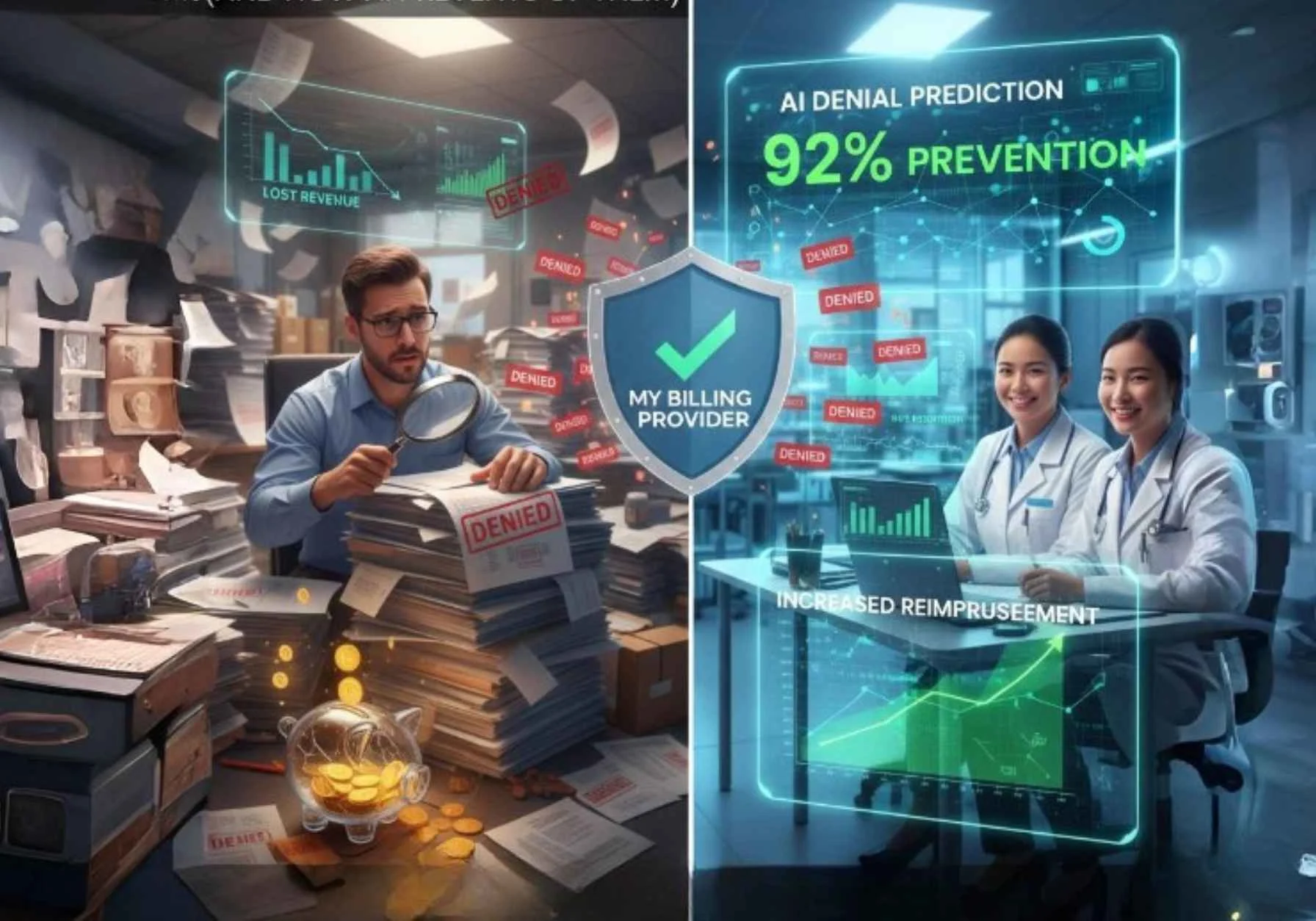
For a mid-sized hospital system, this isn’t just an administrative headache; it’s a direct threat to survival. When you consider that the cost to rework a single denied claim has ballooned to over $25 (not including the potential lost revenue), the financial “bleed” becomes staggering. However, a breakthrough is occurring. By shifting from a reactive “chase the denial” mindset to a proactive approach, AI-powered IPD Coding and predictive analytics are now capable of intercepting and preventing up to 92% of these errors before they ever leave your facility.
In this guide, we dive deep into the medical claim denial reasons 2026 that are currently draining hospital budgets and explore how the latest AI interventions are helping savvy providers prevent revenue leakage.
1. Eligibility Volatility & Real-Time Coverage Shifts
In 2026, the primary reason for claim denials isn’t just “wrong insurance”—it’s eligibility volatility. With the mass redetermination of Medicaid benefits and frequent shifts in ACA subsidies, patient coverage status can change mid-month or even mid-treatment.
Traditional batch eligibility checks performed 48 hours before an appointment are no longer sufficient. If a patient loses coverage the day before surgery and your system doesn’t catch it, the resulting denial is almost impossible to overturn.
- The AI Fix: Predictive eligibility engines now integrate directly with clearinghouses to perform “micro-checks” at every touchpoint—scheduling, check-in, and discharge.
2. Payer-Specific AI Audit Triggers
Insurance payers are now using Natural Language Processing (NLP) to “read” clinical notes at scale. If your documentation says “patient feels better” but you’ve coded for high-acuity care, the payer’s AI will flag a “clinical validation” denial instantly. These are no longer simple clerical rejections; they are attacks on medical necessity.
To combat this, hospitals must reduce claim denials by ensuring that clinical documentation matches the granular requirements of specific payer algorithms.
3. Prior Authorization Micro-Requirements
The CMS Interoperability Rule of 2026 was supposed to make prior auths easier. While it accelerated response times, it also led to payers implementing more “micro-requirements”—tiny, specific clinical data points that must be present to secure an approval. Missing a single lab value or a previous “fail-first” therapy record results in an immediate denial.
4. Coding Specificity and “NOS” Traps
Payers in 2026 have virtually eliminated reimbursement for “Not Otherwise Specified” (NOS) codes. If a coder uses a generic code when a more specific one was supported by the notes, the claim is rejected. This is where AI denial prediction healthcare becomes vital; it can scan a record and prompt a coder: “Clinical notes suggest Type 2 Diabetes with Chronic Kidney Disease; are you sure you want to use the generic code?”
5. Duplicate Claim Logic Errors
As hospitals use more “automated” resubmission tools, payers have beefed up their duplicate detection. Often, a claim is denied as a duplicate simply because a follow-up visit was coded too similarly to an initial visit, even if both were legitimate, separate encounters.
6. Coordination of Benefits (COB) Complexity
With more patients holding multiple insurance plans (e.g., primary employer coverage plus a secondary spouse plan or Medicare Advantage), identifying the “Primary” payer has become a shell game. COB denials are the “silent killers” of cash flow, often sitting in A/R for months while payers argue over who pays first.
7. Timely Filing Deadlines
Payer windows are shrinking. Some private insurers have moved from 365-day filing windows to as little as 60 or 90 days. If a claim gets stuck in a “coding query” loop for too long, it hits the deadline and becomes a total loss.
8. Clinical Documentation Improvement (CDI) Gaps
The final reason is the most fundamental: the gap between what the doctor did and what the coder can prove. In 2026, “if it wasn’t documented with specificity, it didn’t happen.” Missing signatures, absent time-stamps, and vague descriptions of procedures are leading to a 20% increase in medical necessity denials.
The Cost of the Status Quo: A Comparison
| Metric | Manual Denial Management | AI-Powered Prevention |
| Average Denial Rate | 12% – 18% | 2% – 4% |
| Cost Per Reworked Claim | $25.00+ | $1.50 (Automation overhead) |
| Days in A/R | 45 – 60 Days | 28 – 35 Days |
| First-Pass Yield | 75% – 82% | 96%+ |
| Revenue Leakage | High (Write-offs common) | Minimal (Pre-submission fixes) |
How AI Denial Prediction Can Prevent 92% of Denials
The secret to 2026’s high-performing revenue cycles is Predictive Scoring. Instead of sending a claim and “hoping” it pays, modern systems assign a “Denial Risk Score” to every claim before it leaves the building.
1. Risk Scoring Before Submission
AI denial prediction healthcare platforms analyze a claim against millions of historical records and current payer-specific rules. If a claim has an 80% chance of denial due to a missing modifier, the system stops it, flags the error, and sends it back to the coder for a 30-second fix. This “Stop-Gate” mechanism is the single most effective way to prevent revenue leakage.
2. Autonomous Documentation Analysis
Using Natural Language Processing, AI can act as a pre-bill “safety net.” It reads the physician’s unstructured notes and compares them to the assigned DRG. If it finds evidence of a comorbid condition (CC) or major complication (MCC) that wasn’t coded, it alerts the team, ensuring the hospital is reimbursed for the actual complexity of the case.
3. Payer “Rule-Bot” Learning
Payers change their rules constantly. AI agents “crawl” payer portals and analyze thousands of recent EOBs (Explanation of Benefits) to detect new patterns. If a specific insurer suddenly starts denying “Level 4” visits for a certain zip code, the AI detects this trend in days—not months—allowing the billing team to adjust immediately.
Why “My Billing Provider” is the 2026 Solution Your Hospital Needs
The transition to a predictive revenue cycle can feel overwhelming, but it doesn’t have to be. This is where My Billing Provider steps in. We provide the bridge between legacy systems and the future of AI-powered IPD Coding.
Transforming Data into Dollars
At My Billing Provider, our cutting-edge technology doesn’t just “process” claims; it optimizes them. Our algorithms evaluate complex medical records with a level of precision that human teams simply cannot match at scale. We focus on the “Triple Threat” of modern RCM: Accuracy, Efficiency, and Compliance.
- Seamless Integration: We don’t believe in “rip and replace.” Our platform fits effortlessly into your existing procedures, whether you are a small clinic or a massive hospital network.
- Customizable Logic: Every practice has unique challenges. Our AI-powered solutions are customizable to meet the specific requirements of your specialty, ensuring that your unique “denial DNA” is addressed.
- A Human-in-the-Loop Philosophy: While our AI handles the heavy lifting, our committed team of professionals is always available. We provide individual advice and expert oversight, ensuring that the AI’s suggestions are always clinically sound and ethically compliant.
By partnering with My Billing Provider, you aren’t just buying software; you are investing in a dedicated team that is obsessed with your financial performance. We help you uncover new efficiencies, stop the cycle of endless appeals, and finally reduce claim denials for good.
Conclusion: The Choice is Yours
In 2026, the financial health of a hospital is determined by its ability to predict the future. You can continue to hire more staff to chase denials after they happen, or you can implement a “predict and prevent” model that stops the leakage at the source.
With medical claim denial reasons 2026 becoming more complex, the only way to stay ahead is with a partner who understands the technology and the stakes.Are you ready to revolutionize your coding processes and reclaim your revenue? Contact My Billing Provider today to schedule a demo of our AI-powered solutions. Let us show you how we can help you achieve a cleaner, faster, and more profitable revenue cycle.
